Waaaay back in 2010-- Mexico's bicentennial year-- I gave the keynote speech for the meeting of the Board of Directors of the Harry Ransom Center University of Texas Austin, and ever since I have been meaning to post the transcript. Herewith:
TO REMEMBER, TO UNDERSTAND:
ON RESEARCHING AND WRITING
THE LAST PRINCE OF THE MEXICAN EMPIRE
Transcript of keynote for the meeting of the Board of Directors
Harry Ransom Center University of Texas Austin
April 22, 2010
It is such an honor and a delight to be here tonight. First a big thank you to Thomas Staley, Director of the Harry Ransom Center, and Danielle Brunne Sigler, Curator of Academic Affairs. And another big thank you, de corazón, to Mexico's Consul General here in Austin, Ambassador Rosalba Ojeda. It was right here, in the Harry Ransom Center, that Ambassador Ojeda invited me to view the letters of Mexico's Emperor and Empress, Maximilian and Carlota— if you haven't seen these extraordinary documents, you will— they are in the wonderful exhibition "Viva Mexico's Independence." This year, 2010, is a very special year to be celebrating Mexico's Independence, for it is both the bicentennial of Independence and the centennial of the Revolution. Sandwiched in between Independence and the Revolution is the 1860s, the time of Mexico's ferociously resisted second experiment in the monarchical form of government. This is the subject of my novel based on the true story: The Last Prince of the Mexican Empire. Mexico had a prince? >> CONTINUE READING
How many of you have been to Mexico? Well, viva Mexico! Here we are in New Mexico, Nuevo México. On this panel, with Dawn Wink and Kathryn Ferguson, it seems we are all about Mexico.
I write both fiction and nonfiction, most of it about Mexico because that is where I have been living for most of my adult life— that is, the past 30 years— married to a Mexican and living in Mexico City.
But in this talk I would like to put on my sombrero, as it were, as an historical novelist, and although my novel, The Last Prince of the Mexican Empire, is about Mexico, I don’t want to talk so much about Mexico as I do five specific, simple, powerful techniques that have helped me, and that I hope will help you to see as an artist and write across borders and cultures.
Some people have written to me asking about the letter I quote in my novel, The Last Prince of the Mexican Empire, from Don Pedro Montzeuma XV, the sole legitimate descendant of the Aztec emperor, to Maximilian von Habsburg in 1864. Here is the excerpt in the novel-- my translation, edited:
French cannon have cowed some into submission; once tranquility reigns, however, there will rise up all of a sudden a terrible counter-revolution. . . Your Highness has been too precipitous in accepting the Mexican throne . . . Those who today form the regency are of the most impious stripe . . . depraved evildoers, usurpers, they rob the Treasury, they rob even the Holy Church . . . they will supplant Your Highness perhaps after a tragic end.
The actual letter is in Maximilian's archive, and a reprint can be ordered from the Austrian Staatsarchiv in Vienna. There is also a copy of this letter in the Library of Congress's Kaiser Maximilian von Mexiko archive (box 117, chalked on spine, box 118, pages 25-37).
Here is the original excerpt with original spelling and accents:
Porque el canon frances los tiene a algunas amedrentados, mas despues cuando se crea que todo se halla sozegado, estallará de repente una contrarevolucion terrible. V.A. [Vuestra Alteza or, Your Highness] me permitirá le diga que es preciso usar de otros medios que yo conozco como Mexicano, que amo deveras a mi pays y a mis patricios para llegar al fin deseado, pero V.A. ha sido demasiado precipitado en acceptar la oferta al trono de Mexico. V.A. debe refleccionar bien antes de abandonar su patria, a donde se halla feliz y respectado, para emprender su marcha a un pays enteramente desconocido, y que desde 1812 no ha habido un Gobierno ni de hecho ni de derecho, y que tan solo se ha alimentado en una continua guerra interna causada por caudillos ambiciosos y sin principios de ninguna clase; y de manera alguna clasificados para hacer la felicidad de aquellos pueblos. Puedese decir sin escrupulo que los que compenen en el dia la regencia son la estirpe la mas desapiadada y entre ellos hay algunos, o casi todos, que por pruebas autenticas se pueden calificar de malhechores, de deprarados y usurpadores, que han estafado el tesoro publico robado la hacienda ageno, y hasta el culto divino; encadenando la libertad de todo ciudadano tanto Mexicano como estranjero, insultando del modo mas infame las banderas y representantes de todas las potencias estrangeras.
V.A. antes de aceptar cargo de tanto peso, deberia estar sastifecho ue son los pueblos que lo claman que de ellos espontaneamente ha nacido la exigencia que V.A. los Gobierne; y no de tan solo un pequeño numero de aspirantes que su deseo no es mas que la ambición; y que despues de fundada una Monarquia (en caso que asi suceda) ellos mismos sean los primeros que desaprueben al Estrangero que los Gobierna para entre ellos escoger el que mas convenga a sus miras de desolacion y rapiña suplantado a V.A. quiza despues de un tragico fin.
The letter goes on for some pages, and is signed PEDRO MONTEZUMA XV, 17 feb 1864, 116, Rua de meio, Porto
For more about the descendants of Moctzeuma (modern spelling of the name), try wikipedia. Not the best source, I know. I would very much appreciate any references.
One of the highest ranking ladies-in-waiting to Carlota was also a descendant of Moctezuma, Josefa Varela. She makes a couple of brief appearances in the novel. More about her anon.
Pictured left is my pug dog, Picadou, a little tuckered out after her walk at Rosedale, when we were visiting just the other day. Rosedale plays an important part in my novel, The Last Prince of the Mexican Empire, because it was the family home of (prince) Agustín de Iturbide y Green's mother and, later, his home for many years, on and off, until it was sold in the early 20th century.
As I recount in the epilogue of my novel, "The Story of the Story or, An Epilogue by Way of Acknowledgements," when I first began researching the novel in the late 1990s, there was nothing-- and I mean absolutely nothing-- available on-line about Rosedale.
Some other relevant works include Historic Homes in Washington: Its Noted Men and Women by Mary S. Lockwood (NY: Belford Company, 1889); Cleveland Park, an Early Residential Neighborhood of the Nation's Capital by Grace Dunlop Peter and Joyce D. Southwick, and Old Georgetown on the Potomacby Henry Ridgely Evans, Washington DC 1933, which includes the author's personal memoir of his friendship with Agustín de Iturbide y Green, beginning as boys in Georgetown in the late 1860s.
Rosedale, Washington DC Photo: C.M. Mayo
In addition, in the Historical Society of Washington DC's library and other Washingtonian libraries, I found several newspaper articles about Rosedale and the family, a few of which mentioned previously unknown details about the tangle with Maximilian von Habsburg.
[Pictured left is my snapshot taken in the winter of 2000, when Rosedale was still serving as a dormitory for the Youth for Understanding Foundation. It has since been painted a rich honey-yellow and is now a privately-owned residence within the Rosedale Conservancy.]
My research concluded a few years ago; no doubt these libraries have many new articles about Rosedale not listed here. There was a spate of publicity a decade ago, when Elián González, a Cuban boy whose custody was in dispute, found refuge at Rosedale, though, curiously, in not one of the many articles did I find any mention of Rosedale's history with another child whose custody was in dispute: Agustín de Iturbide y Green. (Really, I find that a headshaker.) Subsequently, a few years ago, Rosedale was in the local press again when a dedicated association of neighbors saved it and a small portion of the grounds-- now a community dog park-- from development. The Rosedale Conservancy-- the organization's website-- includes many photos and more information about Rosedale.
Herewith, a list of those older articles focussing on Rosedale:
+++In the Historical Society of Washington DC Library
November 16, 1947, "The President and Mrs Cleveland" by John Clagett Proctor, The Sunday Star
September 1, 1944, "Historic Landmarks of Cleveland Park," by John Clagett Proctor, The Sunday Star
And: a large map showing "Mrs Green" (which is Rosedale) on the Defences of Washington, Extract of Military Map of N.E. Virginia, War Department, 1865
+++In the Martin Luther King Library's Washintongtonia Room
*March 27, 1932, "A Relic of Antiquity," by Gilbert G. La Gorce, The Washington Post
This article is the most detailed. It claims that Alice Green was a youngest child, but this is incorrect (according to a Green family genealogy).
April 1933 (no date), "Phillips' Lease Famous Old Home" Washington Herald
March 23, 1941, "A Might-Have Been Empress Who Lives in Georgetown," by Jane McIlvane, Times-Herald
A very detailed article based on an interview with Agustín de Iturbide y Green's widow, Louise Kearney Iturbide. Erroneously states that upon their marriage in 1915 they lived in her family home, Quality Hill in Georgetown; in fact, the house was sold almost immediately after their marriage and they lived instead at the Pelham Apartments on P St NW, near Dupont Circle.
September 25, 1950 "Cleveland Park's Charm..." by George Kennedy, The Star
A mention with a little detail.
March 28, 1953, "Gen. Forrest's Home Unchaged in 160 years" by E.R. Noderrer, Times-Herald
August 19, 1958, "The Rambler... Visits his Favorite House" by George Kennedy, The Star
Another mention with a little detail.
Spring 1960, Cathedral's New property, Rosedale Estate, Associated with Capital';s Earliest History" by Elizabeth Coonley Faulkner, Cathedral Age
+++Georgetown Public Library's Peabody Room
A terrific resource-- here is where I sat down and read a first edition of Henry Ridgely Evans' memoir, Old Goergetown on the Potomac. They also have a complete collection of Evans' works-- he was a prolific writer, a 33rd Degree Mason, and an expert in magic and occult phenomena.
>>To listen to the podcast of my lecture at the Historical Society of Washington DC, click here.
I wrote about the visit in an essay, "From Mexico to Miramar or, Across the Lake of Oblivion," that was published a few years later, in 2006, in The Massachusetts Review. I think of "From Mexico to Miramar" as "a nonfiction novela about a fairytale." As of last week, the CD, a professionally made recording of my reading of the essay, is back in stock at CDBaby.
In the brief trailer for my book in Spanish, there is a spectacular photo (not mine-- it's istock.com) of Maximilian's sphynx, a souvenir of his visit to Egypt, in front of the towers.
Mexican and U.S. history interlace in so many complex and surprising ways. Just this morning, while perusing the New York Times on my iPad, I happened upon "Lincoln's Mexican Visitor" by Willam Moss Wilson, about President Juárez's ambassador, Matías Romero, and his visit to President-elect Lincoln in 1861.
"Matias Romero arrived in Springfield, Ill. on the evening of Jan. 18, 1861. Though late in the day, he figured it would be easy to find a room in this sleepy midwestern town. But there were no rooms available at his first choice, the American Hotel, or anywhere else: all the hotels in town were full of friends, patronage seekers and the merely curious who had come to meet President-elect Lincoln... " READ MORE
To give you a little perspective, should you require it, 1861 was but a decade and a bit beyond the end of the US-Mexican War, in which Mexico lost vast swaths of its territory. Anyone who was or who intended to rule Mexico had to take into account the still voracious and increasingly powerful neighbor to its north. This was precisely the time when Louis Napoleon was beginning to cobble together the scheme that turned into the so-called "Mexican Expedition" and, with the blessing of the Catholic Church and a not-so-small group of Mexican monarchists, the placement-- in 1864-- of Maximilian von Habsburg upon the Mexican throne.
So: 1861. Matías Romero travels to Springfield. This was no small journey. It was a very savvy political investment, and in making it, Juárez may well have established a solid foundation for later successes, in no small part with the help of the post-Civil War United States, against the Mexican Empire.
William Moss Wilson's is a fascinating article, well worth reading.
P.S. One of the key figures working against the Mexican Empire, and for the reinstatement of the Mexican Republic, was John Bigelow, who served as U.S. Minister to France during and for a brief time after the U.S. Civil War. (He also happened to play a role in the story of "prince" Agustín de Iturbide y Green's American mother's attempts to get her son back from Maximilian--- the subject of my novel, The Last Prince of the Mexican Empire, which is based closely on the true story.) Bigelow's papers, in the Mansucripts Division of the New York Public Library, are an invaluable resource for anyone interested in this period. Bigelow took meticulous note of his meetings with Louis Napoleon, Drouyn de Lhuys (the French Foreign Minister), Dr Evans (the American dentist who played go-between), and E. Gould Buffum, the Paris correspondent for the NY Herald, among others. And of course, there are copies of Bigelow's official correspondence with Secretary of State Seward, as well.
As for Matías Romero's magnificent archive: it is at the Banco de México in Mexico City and can be consulted upon request. Click here for a PDF document by archivist Guadalupe Monroy.
One of the enduring mysteries of Mexico's Second Empire is why, after several years of marriage, Maximilian and Carlota could not have children. In my novel, The Last Prince of the Mexican Empire, which is based on the true story of the scandal of Maximilian's "adoption" of the Emperor Iturbide's grandsons, I leave the reader to continue contemplating the mystery, for there were (and are), so many contradictory theories, many from murky sources and / or clearly and merely malicious gossip and propaganda, and not one of them do I find completely convincing.
That said, there is a theory I favor. I found it in the personal diary of John Bigelow, 1882, which I consulted in the Manuscripts Division of the New York Public Library. The U.S. Minister to France during Mexico's Second Empire / French Intervention, Bigelow later visited Mexico City as a tourist, and there he interviewed Doña Alicia Green de Iturbide, the mother of Agustín de Iturbide y Green, the "last prince." She told Bigelow that Maximilian had tried to engage a Dr Sims of New York to come to Mexico and perform an operation on Carlota, but Dr Sims asked for 30,000 dollars, a staggering sum at that time, and General Almonte refused to support such an expenditure.
Is it true? In all my forays in the archives, I have been unable to find any correspondence with Dr Sims (nor anyone else) on such a matter. However, it can be said that Doña Alicia de Iturbide is a far more credible source than most, for she knew General Almonte (he was the guest honor at her wedding to Angel de Iturbide in 1855, and, in Paris in the summer of 1866, the Almontes and the Iturbides would have been hovering together around the Grand Hotel, in wait for Carlota) and, of course, Doña Alicia herself signed the contract in which the childless Maximilian took custody of her son and nephew in 1865.
In a visit to the New York Historical Society, I did find out this: had Carlota needed surgery, the ideal candidate would have been, indeed, Dr. Sims of New York, for he was the leading gynecologist of his time, well known in Brussels, Vienna, and Paris. Originally from the south, Sims had moved to New York for his health. During the Civil War, he sided with the Confederacy and spent the duration in Paris, where one of his patients was none other than the Empress Eugenie.
Further reading about Dr. J. Marion Sims:
American National Biography, vol. 20, pp. 25-26, Oxford University Press, 1999
The Story of My Life by J. Marion Sims, edited by his son, H. Marion Sims (1884); republished in 1968 with a new preface by C. Lee Burton
Sexual Surgery and the Origins of Gynecology: J. Marion Sims, His Hospital and His Patients, by Deborah Kuhn McGregor, 1990
Women's Surgeon: The Life Story of J. Marion Sims, by Seale Harris, 1950.
[M]y aim is not to write a historical sketch of the reign of Maximilian of Austria, nor is it to give a description of the political crisis through which Mexico passed during that period. My only desire is to furnish the reader with a point of view the value of which lies in the fact that it is that of an eyewitness who was somewhat more than an ordinary spectator of a series of occurrences which developed into one of the most dramatic episodes of modern times.
Academic histories can be a bit dry and, as Yorke puts it, too often the personalities of a period, puppet-like, seem to appear "before the footlights of a fulfilled destiny."
During the brief reign of Maximilian, the author was a young girl living with her family in Mexico City. Every country's capital is a small town, in a sense, but in the 1860s, Mexico City was so small, both literally and figuratively, that this young girl, whose parents were well-connected in both and French and Confederate circles, became acquainted with many of the leading political and military personalities.
She writes, "to those who lived with them when they were MAKING history, these actors are all aglow with life. They are animated by its passions, its impulses," and indeed, she renders them beautifully, compellingly into life.
Before rejoining her family in Mexico City, in Paris, through her guardian, M. Achille Jubinal, a literary figure, antiquarian, and deputy in the Corps Legislatif, she happened to meet none other than the Duke of Morny, Louis Napoleon's half-brother and a key player in the tragedy that was Mexico's Second Empire.
One day in March 1862... M. Jubinal invited me to accompany him to the Hotel des Ventes, Rue Drouot, where an important collection of tapestries and other objects of art was on view to be sold.... My companion was pointing out to me the beauties of a piece which he particularly coveted when some one came behind us and called him by name. We both turned around and faced a middle-aged man whose dress, manner, and general bearing showed him to be a personage of some importance. M. Jubinal, who evidently knew him well, addressed him as "M. le Duc," and his strong likeness to the Emperor [Louis Napoleon], as well as a few stray words, soon led me to guess, even before my guardian had gone through the form of an introduction, that he was no less a personage than the Duc de Morny.
When he learned that her brother had killed by bandits on the highway in Mexico, and she would therefore be leaving France to rejoin her family there, the Duke said: "Lorencz is there now; our army will then be in the city of Mexico; the roads will be quite safe, have no fear." Aficionados of Mexican history will know that this was, in fact, two months before Cinco de Mayo, the massive, humiliating defeat of the French at the city of Puebla.
Her journey from France to Mexico, on an "old patched-up ship," was a sobering one. She writes:
There were only forty passengers on board, and, comparatively speaking, little of the animation that usually precedes the outgoing of an ocean steamer. I found without difficulty the French banker and his Mexican wife who had kindly consented to chaperon me during my lonely journey; and I soon discovered that she and I were the only women passengers on board.
Our fellow travelers were uninteresting-- mostly commercial agents or small tradesmen representing the old-established petty commerce with Mexico. The new order of things was suggested, somewhat ominously, only by the presence of two young surgeons on their way to increase the effective force of the military hospital in Vera Cruz.
Evidently the predicted exodus to El Dorado had not yet begun. Where was the advance-guard of the great army of emigrant capitalists now about to start, and of which I had heard so much?
This was the first serious disillusion of my life, and it left a deep and permanent impression upon my mind.
Later, of her new life in the Mexico City of Maximilian's Second Empire, she writes:
We then lived at Tacubaya, a suburb of Mexico [City] reached by the Paseo, where the marshal [General Bazaine]rode everyday for exercise. Our house was built at the foot of a long hill, at he top of which stood a large old mansion, the yellow coloring of which had won for it the name of the Casa Amarilla. It had been rented by Colonel Talcott of Virginia, who lived there with his family. Dr. Gwin was their guest; and it was arranged that the marshal , when taking his usual afternoon ride with his aide-de-camp, should call upon us one day, and leaving their horses in our partio with his orderlies, should join us in a walkup the hill, casually dropping in en passant at the Casa Amarilla.
The plan had the double advantage of being a simple one and of providing the marshal, who did not speak English, with suitable interpreters. The interview was a long one. The marshal listened to what the American had to say. Indeed, there was little to be said on his own side, as the Mexican ministry was absolutely opposed to the project, and any change of policy must depend upon a change in the imperial cabinet.
His Excellency, however, seemed in high good humor. As we came out, he merrily challenged us to run downhill, much to the astonishment of the few leperos whom we happened to meet. The Mexican Indian is a sober, rather somber creature, not given to levity; his amusements are of a dignified, almost sad nature. He may be sentimental, bigoted, vicious, cruel, but he is never vulgar, and is seldom foolish. Indeed, well might they stare at us then, for it was no common sight in the lanes of Tacubaya to see a commander-in-chief tearing downhill, amid peals of laughter, with a party of young people, in utter disregard of age, corpulence, and cumbersome military accoutrements!
In The Last Prince of the Mexican Empire, my novel based on the true story, Sara and her mother, Mrs. Yorke, appear as minor characters in scenes set in the house of Doña Juliana de Gómez Pedraza, widow of the ex-president of Mexico, aunt of Pepita de la Peña (wife of General Bazaine) and landlady to Don Angel and Doña Alicia de Iturbide (parents of Agustín de Iturbide y Green). (Did I mention, Mexico City was a small town?) Alas, much as I nudged it, my narrative didn't find its wendy-way to Sara's pell-mell trot with General Bazaine. But the fact that Bazaine would do such a such thing informed my portrait of him. For this, as well as so many other portraits, vignettes, and more, I am much obliged to Sara Yorke Stevenson's treasure of a memoir.
Sara Yorke Stevenson went on to make what was then a very unusual career as an archeologist, a leading Egyptologist, and newspaper columnist, which you can read about here.
Carlota de México, Dr Susanne Igler's excellent biography of Mexico's Empress Carlota was published in Spanish by Planeta in 2002 as part of the Grandes protagonistas de la historia Mexicana series edited by Mexican historian José Manuel Villalpando. It offers a complete overview of Carlota's life, from her childhood as the princess of Belgium; her marriage to the Austrian Archduke Maximilian; brief reign as Empress of Mexico; psychotic breakdown in the Vatican; and the long years of her widowhood as a mad yet coddled recluse in Belgium. Igler's biography opens thus (my translation):
A Fairytale Princess
Mexican history is rich in surprising, dramatic, and even grotesque personalities, yet few have so excited the imagination, both collective and artistic, as the woman who, for a fleeting moment, was the Empress of Mexico. Today, more than 130 years after the Mexican State's struggle to define itself, there is abundance of films, soap operas, artistic testimonies, novels, plays, historical debates and -- yes!--- even restaurants named apropos of Maximilian's empire; more than the fleeting and superficial nature of this historical episode would suggest...
The work is amply illustrated with reproductions of portraits (including a charming one of Carlota as an toddler by Winterhalther), and photographs, and includes a chronology and bibliography. This is an important addition to any collection on the Second Empire.
P.S. A bibliography for The Last Prince of the Mexican Empire, my novel about the Second Empire, is here.
Tras las huellas de un desconocido [In the Footsteps of an Unknown](Mexico City: Siglo XXI / Conaculta / INAH, 2008), is a crucially important new work by Dr. Konrad Ratz, Austrian expert on Mexico's Second Empire. Covering a wide range of previously unknown or only superficially explored subjects relevant to Maximilian's life and brief rule in Mexico, Tras las huellas de un desconocido is a both fascinating and entertaining read. As Dr. Ratz writes in his introduction (my translation):
"This book does not attempt to rewrite the complete history of Mexico's Second Empire, but it does aim to fill several gaps in Mexican historiography by bringing forth accounts translated from the German, which because of the language barrier, have not been considered in Mexico. These are not only memoirs and diaries of the period, but also recent monographs, both published and unpublished, in German.
In 1974, the Austrian historian Adam Wandruska (1914-1997) professor at the University of Vienna and a leading expert on the history of the Habsburgs, formed a interdisciplinary group of researchers for an exhibit on "Maximilian of Mexico" at Hardegg Castle in Lower Austria. This had been the property of prince Karl von Khevenhueller, who had fought for Maximilian as commander of the Austrian hussars. Subsequently he became a friend of Porfirio Diaz. This lifelong friendship, apart from various extraofficial diplomatic contacts, greatly contributed to the resumption, in 1901, of diplomatic relations between Mexico and Austria, which had been severed in 1867... ... [In addition to these contributions by Professor Wandruska and his group of researchers, this work] covers the unpublished memoirs of the gardener and botanist Wilhelm Knechtl; the diary of Johann Stefan, first engineer on the Novara; published works on the Austrian Volunteer Corps by Edmund Daniek and on the Mexican Austrian Volunteer Corps by Felix Gamillscheg; the research by Norbert Stein on Father Fischer; a brief but essential and richly detailed work by Johann Lubienski on government institutions under Maximilian, and Felix Wilcek's thesis on Maximilian's income and expenditures in Austria.... [And] in a final chapter I have added a biographical sketch of Egon Cesar Corti, biographer of Maximilian and several other European sovereigns and dignitaries. Unfortunately, given the lack of biographical information and misunderstandings with the University of Vienna, which never offered him a professorship, the 50th anniversary of his death in 1953 went unnoticed in Mexico as well as his native country."
As Mexican historian Patricia Galeana writes in her prologue (my translation),
"...Konrad Ratz's work has great value for Mexican as well as Austrian and European historiographies on the Second Empire. He brings us new details and in such clear prose with short chapters that we may read it as a novel, though it is based on solid foundations thanks to meticulous historical research.... we discover the weaknesses and strengths of Maximilian, the romatic politician who dreamed of being the new Quetzatcoatl, Mexico's savior."
Tras las huellas de un desconocido has my highest and most enthusiastic recommendation. Indeed, no bibliography of Maximilian and the Second Empire would be complete without it.
This blog post originally appeared in a slightly different version in my blog, "Madam Mayo".
***UPDATE Sept 30, 2013**** The text is now available on-line here.
Another Maximilian bibliography note: Mémoires: L'Intervention Française au Mexique by Charles Blanchot. Published in 1911, this very rare memoir by Charles Blanchot, aide-de-camp to General Bazaine, Supreme Commander of French Forces in Mexico during Mexico's Second Empire, took me several years to find. Year after year, I "googled" it until finally it showed up on the page of an antique book dealer in Paris. The price was, in Euros, the equivalent of 700 dollars. I'll admit I waffled. But I am glad indeed that I bought it--- or rather, the 3 volume set with its pages uncut (I had to use a steak-knife to slit them open--- quite an operation).
There is so much in here that has never seen light in either Spanish or English, for instance: the powerful if behind-the-scenes role of Doña Juliana de Gómez Pedraza, widow of Manuel Gómez Pedraza, and the vicious if, as Blanchot suggests, unfounded rumors circulating in Mexico City about Bazaine in 1866-7. Blanchot, who married an American of French origin in Mexico City, also offers a detailed and lively portrait of Mexico City society at the time.
His memoirs informed several scenes in my novel, The Last Prince of the Mexican Empire, in particular, the chapters "March 1, 1866: Basket of Crabs" which includes the mention of the very suspicious and sudden death of French financial expert Monsieur Langlais and "March 4, 1866: Rio Frio," about the murder of Baron d'Huart. Not in my novel but fascinating and sad reading is the chapter on his arrival with General Bazaine in Toulon, France.
This blog post was first published in a slightly different version on my blog, "Madam Mayo."
Welcome! Think of this blog as a kind of bulletin board, pointing out information elsewhere on the web that may of use or interest to you. I'll be updating it every Tuesday, so come back next week-- or, easier yet, subscribe using the orange "feed" button on the sidebar.
I've been researching this strange and tumultuous period of Mexican history for more than a decade, all with the aim of writing my novel, The Last Prince of the Mexican Empire (Unbridled Books, 2009), which is based on the true and very strange story of the half-American, half-Mexican child who was taken into Maximilian's Court in 1865. (Read all about it in the Reader's Guide.) The Spanish translation of my novel, by Mexican poet and novelist Agustín Cadena, El Último príncipe del Imperio Mexicano, will be published in Mexico by Random House Mondadori in the fall of 2010. (Yes, I speak fluent Spanish, but I translate from Spanish into English, not vice versa.)
Why this blog, if my book has already been published? By happenstance and from correspondence with readers and other researchers, I continue to learn about books, articles, documents, websites, photos, songs, artworks, and more about the period, and I'd like to share some these treasures here. I also plan to highlight items from my long-standing Maximilian von Mexiko webpage, which is, like this blog, dedicated to resources for researchers on this richly fascinating period. In addition, I will be reposting selected book reviews and other notes from my writer's blog, Madam Mayo.


 Posts


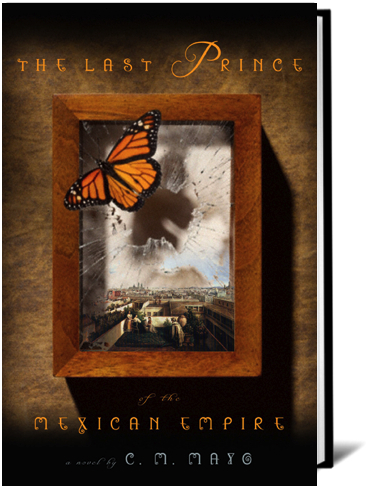 This year, 2010, is a very special year to be celebrating Mexico's Independence, for it is both the bicentennial of Independence and the centennial of the Revolution. Sandwiched in between Independence and the Revolution is the 1860s, the time of Mexico's ferociously resisted second experiment in the monarchical form of government. This is the subject of my novel based on the true story: The Last Prince of the Mexican Empire.


 Eighteenth Century Country Estate of General Uriah Forrest, Cleveland Park, Washington, D.C


