Tuesday, April 26, 2011

La Cara Oculta, Podcasting, Kindle and iBook


No blog post on research this week because I'm out of the office, in part to film an interview for Francisco Martin Moreno's program "La Cara Oculta" for TV Azteca (check out the on-line "Reader's Guide" / "Guía de lectura" to The Last Prince of the Mexican Empire for the basic story).

Another bit of business: the podcast page has been updated with substantially wider bandwidth.

Yet more business: readying the e-book (Kindle and iBook edition) of the Spanish translation, El último príncipe del Imperio Mexicano. I hope to have news about this very soon. Currently the paperback edition is available in Spanish (a superb translation by Mexican novelist and poet Agustín Cadena) from Grijalbo Random House Mondadori.

Check in again next Tuesday: more books on the period, plus a story about pears.

Tuesday, April 19, 2011

Rosedale, the Historic Estate in Washington DC

Pictured left is my pug dog, Picadou, a little tuckered out after her walk at Rosedale, when we were visiting just the other day. Rosedale plays an important part in my novel, The Last Prince of the Mexican Empire, because it was the family home of (prince) Agustín de Iturbide y Green's mother and, later, his home for many years, on and off, until it was sold in the early 20th century.

As I recount in the epilogue of my novel, "The Story of the Story or, An Epilogue by Way of Acknowledgements," when I first began researching the novel in the late 1990s, there was nothing-- and I mean absolutely nothing-- available on-line about Rosedale.

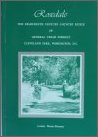
I found my way into the story by visitng the Historical Society of Washington DC, where I came upon the privately published and beautifully researched book by Louise Mann-Kenney, Rosedale: The Eighteenth Century Country Estate of General Uriah Forrest, Cleveland Park, Washington, D.C. (1989).

Some other relevant works include Historic Homes in Washington: Its Noted Men and Women by Mary S. Lockwood (NY: Belford Company, 1889); Cleveland Park, an Early Residential Neighborhood of the Nation's Capital by Grace Dunlop Peter and Joyce D. Southwick, and Old Georgetown on the Potomac by Henry Ridgely Evans, Washington DC 1933, which includes the author's personal memoir of his friendship with Agustín de Iturbide y Green, beginning as boys in Georgetown in the late 1860s.

Rosedale, Washington DC  Photo: C.M. Mayo
In addition, in the Historical Society of Washington DC's library and other Washingtonian libraries, I found several newspaper articles about Rosedale and the family, a few of which mentioned previously unknown details about the tangle with Maximilian von Habsburg.

[Pictured left is my snapshot taken in the winter of 2000, when Rosedale was still serving as a dormitory for the Youth for Understanding Foundation. It has since been painted a rich honey-yellow and is now a privately-owned residence within the Rosedale Conservancy.]

My research concluded a few years ago; no doubt these libraries have many new articles about Rosedale not listed here. There was a spate of publicity a decade ago, when Elián González, a Cuban boy whose custody was in dispute, found refuge at Rosedale, though, curiously, in not one of the many articles did I find any mention of Rosedale's history with another child whose custody was in dispute: Agustín de Iturbide y Green. (Really, I find that a headshaker.) Subsequently, a few years ago, Rosedale was in the local press again when a dedicated association of neighbors saved it and a small portion of the grounds-- now a community dog park-- from development. The Rosedale Conservancy-- the organization's website-- includes many photos and more information about Rosedale.

Herewith, a list of those older articles focussing on Rosedale:

+++In the Historical Society of Washington DC Library

November 16, 1947, "The President and Mrs Cleveland" by John Clagett Proctor, The Sunday Star

September 1, 1944, "Historic Landmarks of Cleveland Park," by John Clagett Proctor, The Sunday Star

And: a large map showing "Mrs Green" (which is Rosedale) on the Defences of Washington, Extract of Military Map of N.E. Virginia, War Department, 1865


+++In the Martin Luther King Library's Washintongtonia Room

*March 27, 1932, "A Relic of Antiquity," by Gilbert G. La Gorce, The Washington Post
This article is the most detailed. It claims that Alice Green was a youngest child, but this is incorrect (according to a Green family genealogy).

April 1933 (no date), "Phillips' Lease Famous Old Home" Washington Herald

March 23, 1941, "A Might-Have Been Empress Who Lives in Georgetown," by Jane McIlvane, Times-Herald
A very detailed article based on an interview with Agustín de Iturbide y Green's widow, Louise Kearney Iturbide. Erroneously states that upon their marriage in 1915 they lived in her family home, Quality Hill in Georgetown; in fact, the house was sold almost immediately after their marriage and they lived instead at the Pelham Apartments on P St NW, near Dupont Circle.

September 25, 1950 "Cleveland Park's Charm..." by George Kennedy, The Star
A mention with a little detail.

March 28, 1953, "Gen. Forrest's Home Unchaged in 160 years" by E.R. Noderrer, Times-Herald

August 19, 1958, "The Rambler... Visits his Favorite House" by George Kennedy, The Star
Another mention with a little detail.

Spring 1960, Cathedral's New property, Rosedale Estate, Associated with Capital';s Earliest History" by Elizabeth Coonley Faulkner, Cathedral Age


+++Georgetown Public Library's Peabody Room

A terrific resource-- here is where I sat down and read a first edition of Henry Ridgely Evans' memoir, Old Goergetown on the Potomac. They also have a complete collection of Evans' works-- he was a prolific writer, a 33rd Degree Mason, and an expert in magic and occult phenomena.


>>To listen to the podcast of my lecture at the Historical Society of Washington DC, click here.


Tuesday, April 12, 2011

On the Death of Maximilian: A rare Hungarian Newspaper Article from 1876


An eyewitness memoir by Dr Szender Ede, who served with the French in Mexico from 1865, and later had quite a bit to do with the aftermath, was published in a Hungarian newspaper in 1876, and has been translated into Spanish. Warning: it's not for the timid of stomach.

> You can read it here.

Yes, I hope to translate it into English soon.

Pictured left is my photo of Maximilian's temporary coffin, in Querétaro. You can see more of my photos from Querétaro here.

Next post: next Tuesday.

Tuesday, April 5, 2011

Carlota's Piano

So far readers have alerted me to a crystal flute, a saddle, a set of mirrors, and a diamond ring-- and now, Carlota's piano. A fun connection: writer John Randolph Bennett was writing to interview me about Dancing Chiva Literary Arts, my new venture in publishing, among other things, Maximiliana, and in his e-mail he wrote:

[When] I was a boy growing up in San Jose, CA, we used to buy sheet music as a store called Reid's Music. Somehow they had acquired Empress Carlotta's piano, and they displayed it on a dais in the center of their store. They called it the Empress Carlotta Grand. I remember it being ornate; it may have been painted a brassy gold. I think I got to play it once.

In response to further questioning:

"I just Googled 'Empress Carlotta Grande Piano' and found a listing in an auction house from 2010. This is how I remember the piano looking. Look at the golden color of that wood! Hard to imagine it sitting on a platform by the escalators in a big store in a shopping mall in San Jose."

Here's the result of that "google": M.S. Rau of New Orleans is offering the piano for sale for USD $225,000. From the on-line catalog:

Royal provenance and superior craftsmanship culminate in this highly important grand piano, owned by the Empress Carlota of Mexico and made by the famed London firm of Collard & Collard. The piano was given to the Empress by her brother-in-law, Emperor Franz Joseph of Austria, on the occasion of her 25th birthday in 1865.

The piano itself is a work of art. The body is crafted of luxurious birds-eye maple, polished to a sleek, smooth finish and complemented with scrolling gold gilt wood accents. Three shimmering gold gilt wood legs, hand-carved in the Rococo style, support the entire structure, which, despite its impressive size, seemingly floats in its space. Additional highlights include original ivory and ebony keys, original "certificate of authenticity" by Collard & Collard, and a plaque stating this magnificent instrument was a gift to the Empress.

This piano was housed in the Empress' private quarters in Chapultepec Castle, where she would often sit and play her favorite classical compositions. When the rule of the Empress and her husband, Emperor Maximillian I, ended in 1867, a few pieces of the castle's contents (including this piano) became the property of Mexican government officials.... CONTINUE READING


One of the very few liberties I took with historical facts in my novel, The Last Prince of the Mexican Empire, had to do, precisely, with this piano. For the chapter set in September of 1865, I wanted to introduce the two grandsons of the Emperor Iturbide, Salvador and Agustín (the prince of the novel's title), apart from their family, and show the strangeness of their having been brought into Maximilian's household. I set the scene for the two boys, one an adolescent, the other only 2 and 1/2, in Chapultepec Castle, the Imperial residence, where they come upon the piano. In fact, Salvador had already been taken to school in Paris-- but this was a small liberty, and worth taking for narrative integrity, I think. I also imagined the piano being dark--wrong I was! That will be corrected in the next edition.

I'll be on a brief blog vacation, so next the post will be on Tuesday April 19th.

If you'd like news about Dancing Chiva's forthcoming ebooks on Maximiliana, we'd love to have you join the mailing list. We hate spam, too, so the newsletter goes out only 5 - 6 times a year, and you can opt out at any time.

Tuesday, March 29, 2011

Doña Cordelia (Otilia) Jordan de Degollado


In 1923, shortly before the death of the ex-Empress Carlota in Belgium, a Mexican newspaper reporter (or perhaps a pair of them), tracked down the then elderly Doña Cordelia (Otilia) Jordan de Degollado, the American widow of the Mexican Empire's never-received ambassador to Washington. I found the newspaper clipping in the Joaquín and Mariano Degollado archive at the University of Texas, Austin. Here is my translation from the Spanish. (Alas, the article did not carry the reporter's name. It opens with mutliple subtitles, as it appears here.)


A Lady of Carlota's Court Tells How She Lived in Mexico

The sovereign is near death


Señora Cordelia Jordan de Degollado


Yesterday She Recalled the Times of the so-called Empire of Maximilian


—A VERY INTERESTING STORY—


During that Ephemeral Empire, this Lady was Maximilian's Ambassadress Near the White House

The rumors of the ex-empress Carlota's grave illness published in European newspapers and later, in the Mexican press, inspired us to interview a distinguished octogenarian resident in this capital who was a member of the court of Maximilian von Habsburg's ephemeral imperial government. We refer to the elderly Doña Cordelia Jordan, widow of Degollado, who lives in an apartment at number 41, Calle de Roma, in the Colonia Juárez, and that is where we arrived, accompanied by our photographer.

After inquiring with the concierge of this immense apartment building, we presented ourselves at the door that belongs to Degollado's widow and although at first the servants who attend her showed great reluctance in admitting us, we were finally able to obtain from the kindly señora some interesting stories about her life in the Court of the Emperor.

The apartment occupied by the widow of Degollado is soberly decorated and it seems there are furnishings, portraits and objects in the living room from that epoch of our history. The individuals in the large frames are clearly from those times; the ladies in their crinolines and luxurious dresses of taffeta, and the men in their Directory-style frock coats.

After we had a look around the small living room, where upon the table there were some elegant albums containing many antique portraits, we passed into the sitting room, where, in a wide chair, there reposed the elderly Señora Degollado.

She receives us with great kindness and invites us to sit down; her two "companions," two Mexican women dressed imppecably although with the modesty of our servants, pull up some chairs and immediately place themselves at the señora's side, while, from the little box very near the señora's feet, where it was sleeping when we arrived, a tiny chihuahua growls and threatens to bite us. Seated in her immense chair, the widow of Degollado still has some remains of her former grandeur: a fine wool poncho covers her legs and she wears a wide cream-colored and blue blouse, and, covering her white head, a delicate cap of Irish lace.

She apologizes for having not received us at first, explaining that since she lives alone, she was afraid we might rob her, as she has no more company than four servants and her housekeeper, Antonia, whom she treats with great affection. Antonia is the one who opened the door. Our distinguished interviewee explains that she has lost almost all her sight and furthermore, can no longer get up from her chair, since she suffered a serious fall some twenty years ago when, passing by in her buggy, her horse bolted, dragging her to the ground. She also tells us that in recent years she has suffered three serious episodes of pneumonia which brought her to the edge of the grave; finally, however, she has recovered, though the years have wrought havoc upon her.

SHE WAS AMBASSADRESS IN WASHINGTON

She herself tells us that she is American and was born in the state of Virginia, having married Mariano Degollado when he was just beginning his studies in a university near Washington. At that time the Jordan family lived near the university, which is how she met the young Degollado, with whom she first became friends. After a long engagement, they were married in a Catholic church in the same region. Afterwards, just after the Archduke Maximilian had been crowned Emperor, they came to Mexico and her husband directly participated in the historical developments in Mexico.

The señora tells us the story of this tragic episode in Mexico, using a clear English and very little Spanish, for, as she tells us, she doesn't speak that language well. In fact we noticed that she speaks to her servants in English and although they do not speak a word of that language, they manage to understand her.

Mariano Degollado soon became involved with the men of this government and his wife was named lady-in-waiting, while he became one of the Emperor's favorite chamberlains and, as she herself tells us, the Emperor came to have great affection for him.

REMINISCENCES OF THOSE TIMES

Bit by bit the estimable old lady begins to offer details and she tells us about some details of the life of the Court. We try to note everything that falls from her lips; it seems to us at times that history itself is speaking to us.

"Why did they kill Maximilian? Ah! I think they should not have done that. He was very good and Mexico lost the affection of the world."

Now and again the señora lets out an exclamation and it seems her deep set eyes will cloud with tears. Later she tells us that the Emperor cared very much and about others and he had a special concern to alleviate the sufferings of the poor. Carlota was the same, constantly making works of charity and in the Court there were rarely conversations about anything but some fiesta to help the less fortunate.

"I still remember very well the day we said goodbye to the Emperor, when he left for Querétaro. Those were very bitter days and since that time one could say we began to suffer great difficulties. We were truly devastated by the execution of Maximilian and his loyal generals. We could hardly believe it, and once we realized it was true, we had to emmigrate to Guatemala, where President Cerna had offered a place for all the refugees."

Then, Señora de Degollado tells us that during the Empire the city was better, more tranquil, cleaner, and the economic situation was better than it was in the years afterwards. "I don't mean to say it was better than it is now, not at all," she tells us, "because now, naturally, it has progressed very much. But there really was much more tranquility and everyone was content."

It was only some months after he had arrived in Mexico when Señor Degollado was named Imperial Ambassador to Washington, where he went, accompanied by his wife. Nevertheless, as Maximilian's government had not been recognized by that of the United States, the señora tells us that they were never received at the White House, having then departed for New York, to take charge of the Imperial Consulate of Mexico. They stayed there for some months, when they were recalled by the Emperor and, before leaving, delivered from the offices more than 20 thousand dollars in cash to a South American whose name Señora Degollado cannot recall. The fact is, very soon afterwards, that South Amerian disappeared with the 20 thousand dollars.

They continued in the Court until it was overthrown. There was a truly imperial luxury; the Empress Carlota tried to imprint upon the life of the Palace a most exaggerated luxury, similar to that of the European courts.

Later, in exile, Señor Degollado was named Governor of the Atlantic coast by the President of Guatemala, having stayed there for four years following Maximilian's execution. They were able to return to Mexico when President Juárez declared a general amnesty.

We ask Señora Jordan de Degollado what was her impression of Don Benito Juárez and if she could say anything about the men of that time; but she refused to speak about them, for she had never liked politics very much.

She also told us that she had been in Mexico for 50 years and although for much of that time she has been enclosed in her rooms, nonetheless, she knows about many episodes of our history. She has some family in the state of Virginia and never had children. Her nephews in the United States take care of her properties and periodically they send her some funds for her expenses. Her entire world in Mexico is limited to her servant Antonia, her four other servants and her "Chiquita," the little chihuahua, who, during our interview, never ceased to look at us with her shining eyes, as if wanting us to leave, for were were intruders.

Señora Degollado also told us about Señora Doña Guadalupe Orán, who is still living and who, with her and the Empress Carlota, are probably the last three ladies who remain from that ephemeral reign.

As recently as about ten years ago she received some letters from the Empress Carlota, but since then, she has had no news of her, only that which we announce in our visit, about her very delicate state of health.

Nothing impresses the senora Degollado anymore and we sincerely believe that she would have heard of the death of the Empress Carlota very naturally, for when she noted that both were about the same age, she added:

"Poor Carlota, she suffered very much."

We did not want to tire the elderly lady by bringing to mind such memories and so we thought it best to take our leave, and also say goodbye to Antonia, her kind and affectionate companion, as well as to "Chiquita," the loyal little dog that, with so much humilty, sleeps on her lap.

# # # To read the original version in Spanish, visit http://www.cmmayo.com/maximilian-cordelia-degollado.html

Tuesday, March 8, 2011

Brief Haitus until March 29


This blog is updated on Tuesdays but as I'll be traveling, the next post will be on Tuesday March 29th.

Still to come: more about Gillow in Rome; the Salm-Salms; Carlota's letters; the Carlota colony, and more.

P.S. To be alerted about events and news, join my mailing list for a free, brief and informative newsletter sent out 5 - 6 times per year. (I do not share my mailing list and as I use mailchimp, a leading e-mail service, you can instantly opt out at any time.)

Tuesday, March 1, 2011

Miramar Castle or Il Castello di Miramare, Maximilian and Carlota's Residence in Trieste

Miramar Castle or Il Castello di Miramare, in Trieste, was Maximilian and Carlota's residence before coming to Mexico. It's a very curious place, and my own visit, back in 2003, as part of my research for my novel The Last Prince of the Mexican Empire / El último príncipe del Imperio Mexicano was enormously and, to me, surprisingly, valuable.

I wrote about the visit in an essay, "From Mexico to Miramar or, Across the Lake of Oblivion," that was published a few years later, in 2006, in The Massachusetts Review. I think of "From Mexico to Miramar" as "a nonfiction novela about a fairytale." As of last week, the CD, a professionally made recording of my reading of the essay, is back in stock at CDBaby.


More Miramar links:

Official website of Miramar Castle
(In English, Italian, French and German.)

The Treaty of Miramar

Photos from my visit to Miramar, winter 2003

In the brief trailer for my book in Spanish, there is a spectacular photo (not mine-- it's istock.com) of Maximilian's sphynx, a souvenir of his visit to Egypt, in front of the towers.

Tuesday, February 22, 2011

Maximilien: Ópera historique en 3 actos et 9 tableaux

A couple of years ago, the late great Mexican art historian Don Ricardo Pérez Escamilla very generously gave me his copy of a rare French libretto and program of the opera performed in the Académie Nationale de Musique et de Danse, Maximilien (libretto by R.S. Hoffman; adapted from the work by Franz Werfel; French adapted version by Armand Lunel; music by Darius Milhaud). The libretto was published in 1931 in Vienna.

The cast of characters (my translation):

Maximilian, Archduke of Austria, Emperor of Mexico (Baritone)

Carlota, Empress of Mexico (Soprano)

Princess Agnes Salm-Salm (Mezzo)

Chancellor Stefan Herzfeld, childhood friend of Maximilian (Baritone)

Tomás Mejía, Mexican General serving the Monarchy (Tenor)

Colonel Miguel López (Tenor)

Francois Achille Bazaine, Marshal of France, Commander-in-Chief of the Expeditionary Forces (Baritone)

Monsignor Pelagio Labastida, Cardinal of Mexico City and Puebla (Bass)

Three Mexican Republican generals reporting to Don Benito Juárez)
Porfirio Diaz (Bass)
Riva Palacio (Tenor)
Mariano Escobedo (Bass)

The Mayor (Basse)


CHORUSES

Indigenous People and Notables (Men)
Maximilian's Guests (Mixed)
The Crowd (Mixed)
Rebellious Soldiers, Indigenous People, etc. (Mixed)
The Delegantes of the Junta (2 tenors)
The Generals (2 tenors, 2 baritones)
Imperial Soldiers (Men)
The Crowd of Querétaro (Mixed)
Guards (2 tenors, 2 baritones)
An Officer and the Firing Squad - a Chaplain (Mute actors)
Republican Crowd (Mixed)


For more operas and musicals about Maximilian and Carlota, scroll down to the bottom of the Maximilian von Mexiko links page.

Next post next Tuesday.

Tuesday, February 15, 2011

John Bankhead Magruder: A Military Reappraisal by Thomas M. Settles

As the subtitle indicates, most of Thomas M. Settles' splendid biography of John Bankhead Magruder (1807 - 1871) is dedicated to a detailed examination of his role in the U.S. Civil War, specifically, his audacious if nonetheless inevitably doomed defense of Richmond, and later, Galveston. Though this part of the narrative does not have direct bearing on Mexican history, it informs the portrait of an unusually flamboyant Confederate who, in defeat, looked south to a future in Maximilian's Mexican Empire.

Based on three decades of archival research, this biography must have been a titanic task, for Magruder left no diary and many of his most important papers were lost in a San Francisco fire. Worse, he was much maligned during his lifetime, victim of both malicious gossip from his Confederate rivals and less than sympathetic Federals-- just the sort of thing to send a biographer down blind alleys. In addition, there were misunderstandings, as when earlier historians, in recounting what appeared to be a less-than honorable leave-taking from Washington DC at the start of the Civil War, confounded Magruder with a relative.

General John Bankhead Magruder was, as Settles convincingly argues-- backing every point with what sometimes seems a forest of footnotes-- a Civil War general whose tactical ingenuity and tenacity are deserving of far greater respect than he has been accorded. Most of the book details his early military career, from West Point to a garrison duty and recruiting at various army posts from the Carolinas to Maine, until, with the invasion of Mexico in the late 1840s, his fortuntes took a radical turn. Along with many of the men who would later play major roles in the U.S. Civil War-- Grant, Lee, and McClellan, among them-- Magruder distinguished himself in several major battles against the Mexicans. (Magruder's artillery was, in fact, the first to fire upon Chapultepec Castle.) Following the U.S.-Mexican War, Magruder served in California, where in Los Angeles, briefly, he ran a saloon.

He was on a visit to Europe when recalled to Washington DC in 1861, only a month before his native state of Virginia seceded. He had not wanted to leave the U.S. Army, but as "he could not fight against his own people," he resigned, calling it "the most unhappy moment of my life." He walked across the Potomac, offered his services to the Confederacy and, in short order, was reporting to Robert E. Lee.

Settle's treatment of Magruder's return to Mexico in 1865, in the final chapter, "Postwar Odyssey," is a relatively brief one; nonetheless, it is an important contribution to understanding the nature and role of the ex-Confederates in Maximilian's government.

At the end of the U.S. Civil War, General Magruder was one of several thousand ex-Confederates who pulled up stakes for Mexico. In 1865 the French Imperial Army, considered the greatest in the world, occupied most, if not all of Mexican territory, while the ex Archduke of Austria, Maximilian, a direct descendant of the King of Spain during the Conquest, reigned as Emperor. Though by the late summer and fall of 1865, when the ex-Confederates began arriving en masse, the French occupation was beginning to fray at the edges, Maximilian and his consort, Carlota, still presided over a court and elaborate palace balls and other festivities that were, to Americans at that time, considered the height of glamor. In the words of journalist William V. Wells, this was the "high noon" of the empire, when it was impossible for many to even imagine the catastrophe that would, in only a matter of months, befall the "cactus throne."

Some ex-Confederates came to Mexico because they could not bear living in a defeated South, others, because they had expected to participate in a dynamic plantation economy under the French-backed Maximilian (who, to entice the ex-Confederate colonists, proclaimed slavery legal in Mexico). But others, such as General Magruder, simply felt pushed out. As Settles writes:

"It must have been extremely difficult for so proud a man as John Bankhead Magruder to have signed the articles surrendering the Trans-Mississippi Department. But when the Federals began arresting and imprisoning high Confederate officials, he resolutely refused to submit to such personal humiliation. He was not eligible for the amnesty proclaimed by President Lincoln on December 8, 1863, or that proclaimed by Andrew Johnson on May 29, 1865"

Although I had spent several years researching Mexico's Second Empire under Maximilian for my novel, The Last Prince of the Mexican Empire, until recently, I was flummoxed as to the background of the author of the exceedingly rare English language memoir, Sketches of the Last Year of the Empire, Henry R. Magruder. It turns out he was the son of General John Bankhead Magruder and I now know, from Settles' biography, that father and son did not arrive in Mexico via the same route. General Magruder came down overland from Houston with General Shelby, while his wife, son Henry, and unmarried daughter, Kate Elizabeth, arrived via Veracruz, for they had come from Florence, Italy, where they had been residing for some years. As Settles explains,

"[B]ecause of the hardships of travel, uncomfortable living conditions, and extremes of climate found in the remote locales where magruder was stationed during his military career, [Mrs Magruder] found it more practical to live and raise her children in the comforts of Baltimore, where she could stay closer to family business interests. She remained there until 1850 when, as a consequence of [daughter] Isabella's ill health, she took her children to Europe. Mrs Magruder had relatives in Germany, but she moved to Italy, living briefly in Rome, then in Florence."

From Texas, not yet reunited with his family, Magruder headed straight down to Monterrey and then to Mexico City, arriving in the summer of 1865. Writes Settles:

"Magruder checked into a room on the first floor of the fashionable Iturbide Hotel, and there he received several distinguished visitors, including Matthew Fontaine Maury and his old friend Marshal Francois-Achille Bazaine, now in command of the imperial forces in Mexico. He also met with the British minister to Mexico, Sir Peter Campbell Scarlett, whose nephew, Lord Abinger, had married Magruder's niece, Helen Magruder, in Montreal several years earlier."

It appeared Magruder felt as at home as an American could be in Mexico City. He bought himself a new wardrobe, "'a cut-a-way suit of salt and pepper color, with a tall dove-colored hat and patent leather boots,' and then went to the palace of Montezuma [the Imperial Palace], which Scott's army had victoriously occupied eighteen years earlier."

Soon after a successful interview with Maximilian and Carlota, Magruder, now a naturalized Mexican citizen, was appointed head of Maximilian's Land Office of Colonization. The idea was to establish colonies along the main route inland from Veracruz to Mexico City, on land Juarez (under the Republic) had expropriated from the Church.

Settles covers the rapid collapse of the scheme along with Maximilian's government, and Magruder's return to the U.S. In 1867-- surprisingly, for memories of the Civil War remained fresh--- he attempted to set up a law office in New York City. His family had returned to Italy, but he remained in the U.S. to work the lecture circuit with a crowd-pleasing talk on Maximilian and Carlota. He was on that tour when, in a Houston hotel in 1871 he died of a stroke.

In sum, this is an important addition to the bibliography on Confederates in Mexico, and crucial reading for anyone who studies the U.S. Civil War, the U.S.-Mexico War, and / or Mexico's Second Empire. Highly recommended.

Next post: next Tuesday.

Tuesday, February 8, 2011

Confederates in Mexico: A Brief Bibliography

An exotic but enduring subject of interest among U.S. Civil War history aficionados is the role played by Confederates, such as Commodore Matthew Fontaine Maury (pictured right), and later, a passel of ex-generals (Shelby, McGruder, and more), in lending, or perhaps I should say, attempting to lend prestige to Maximilian's monarchy in Mexico. After the surrender at Appomattox in 1865, an important number of ex-Confederates immigrated to Mexico, many (though not all) with the aim of establishing colonies. To war-weary ex-Confederates, Maximilian's Mexico might have appeared a delectable glass of water, but as quickly as if left out in the Mexican sun, it evaporated. In general, the ex-Confederates' stay south of the border was short, their attempts at establishing colonies intensely frustrating, and, ultimately, catastrophic, for by early 1866, Maximilian's government, bankrupt and demoralized, and having lost its French ally, was crumbling before the Juarista onslaught. Maximilian himself was captured, tried, and then executed by firing squad in June of 1867.

[Pictured right: General Joseph Shelby]

My own sense is that there is much still to be written about the ex-Confederates in Mexico, for so many of the historians of Mexico's Second Empire have lacked funding, or simply the wherewithal, to delve into the relevant Confederate archives, and vice versa--- it's nothing new that even otherwise beautifully educated Americans are more often than not woefully ignorant about Mexico and Mexican history, and, alas, the Spanish language. Serious research into the ex-Confederates in Mexico requires, at a minimum, three or more languages (Spanish and English, of course, plus French and German-- and the more German the better); deep knowledge of both Mexican politics, and Confederate politics, as well as culture, geography, terrain, mid-19th century farming practices, economics, and more. And not only all this: Mexico's Second Empire / French Intervention is an essentially transnational period, which is incomprehensible without an understanding of European and American geopolitics. Among the European actors in Mexico's French Intervention: France, of course, Austria and its dominions, Belgium, England, Spain, and-- vitally--the Vatican.

(Ay, not something to research just over a weekend! It took me more than seven years to research and write my novel about the true story of the half-American prince, Agustin de Iturbide y Green, in Maximilian's court, and I am still awed by the amount of research I could yet undertake... and I am so often tempted... )


To return to the point of this blog, which is to share my research, and so make it easier for other researchers to cover new ground:

Herewith, the major titles on the specific subject of Confederates and ex-Confederates in Mexico during the reign of Maximilian (and please leave a comment if you know of any title(s) I may have overlooked-- though, please note, with the exception of Stevenson, I am not including works that cover Maximilian and the Second Empire generally, or adventures not specifically about the Confederates, e.g., Blasio, Corti, Haslip, Niles, Pani, Ratz, Ridley, the Salm-Salms, et al. ):

Harmon, George D., "Confederate Migration to Mexico," The Hispanic American Historical Review (Nov., 1937)

Arthur, Anthony, General Shelby's March (Random House, 2010)
Note: This may be the most important recent addition to the literature on Confederates in Mexico. Alas, Arthur passed away in 2009. As soon as possible, I will make a note about this work on this blog.

Davis, Edwin Adams, Fallen Guidon: The Saga of Confederate General Jo Shelby's Expedition to Mexico (TAMU Press, 1995)

Edwards, John N., Shelby's Expedition to Mexico (Kansas City, 1872)
Note: the link is to a new edition, edited by Conger Beasely, Jr. (University of Arkansas, 2007)

Hanna, Alfred Jackson, "Role of Matthew Fontaine Maury in the Mexican Empire," An address before the annual meeting of the Virginia Historical society, January 17, 1947

Harter, Eugene C., The Lost Colony of the Confederacy (University of Mississippi Press, 1985)

McGruder, Henry R., Sketches of the Last Year of the Empire (London, 1868)
Note: The author was the son of General Magruder. The link is to my blog post about his book.

O'Flaherty, Daniel, General Jo Shelby (1954; reprint 2000)

Padgett, James A., ed., "Life of Alfred Mordecai in Mexico 1865-1866, as Told in His Letters to His Family (North Carolina Historical Review, April 1946 and January 1946)

Rister, Carl Cooke, "Carlotta, a Confederate Colony in Mexico" Journal of Southern History 11, February 1945

Mahoney, Harry Thayer and Majorie Locke Mahoney, Mexico and the Confederacy, 1860-1867 (San Francisco: Austin & Winfield, 1998),

Rolle, Andrew F., The Lost Cause: The Confederate Exodus to Mexico (University of Oklahoma Press, 1965)

Ruiz Ramón Eduardo, ed., An American in Maximilian's Mexico, 1865-1866: The Diaries of William Marshall Anderson (San Marino, 1959)

Terrell, Alexander Watkins, From Texas to Mexico and the Court of Maximilian in 1865 (Dallas, 1933).

Settles, Thomas M., John Bankhead Magruder: A Military Reappraisal (LSU Press, 2009)

Stevenson, Sara Yorke, Maximilian in Mexico: A Woman's Reminiscences of French Intervention 1862-1867 (The Century Co., 1897)
(The link goes to my blog post about this wonderful and very richly detailed eyewitness memoir.)

Williams, Frances Leigh, Matthew Fontaine Maury: Scientist of the Sea (Rutgers University Press, 1963)


+++++++++++++

>>Finally, different as they are, the novel by Elizabeth Boatright Coker, The Grasshopper King (1981), and the movie The Undefeated (1969), starring John Wayne and Rock Hudson, both have to do with the saga of the Confederates in Mexico.

>>Confederate characters appear in Fernando del Paso's novel Noticias del Imperio and, fleetingly, in my novel, The Last Prince of the Mexican Empire.

>>For a general selected bibliography of the Second Empire, please visit my "Maximilian" page.


Next post next Tuesday.

Tuesday, February 1, 2011

Monseñor Eulogio Gillow, the Iturbides, and the ex-Hacienda de Chautla


One of the most moving and curious things about having written a book about the 19th century is that, on many an occasion, I am reminded that it wasn't all that long ago. True, everyone alive in the 1860s is long dead, but there are many people alive today who knew people who knew those people*. I'm not yet 50, and I remember my great grandmother, who grew up in the house of her uncle, William Wirt Calkins, who fought in the U.S. Civil War and wrote the magnificent History of the 104th Illinois. Several descendants of the people upon whom I based the characters in my novel have written to me; I am more grateful and touched than I can say. And there are others, who are not related, but have shared letters, documents, photographs, books, and more. One, a Mexico City editor and historian, a relative of Monseñor Eulogio Gillow, lent me a copy of Gillow's rare and very illuminating memoir, which was published, alas, obscurely, in Spanish in 1921 in Los Angeles. I had never, in all my several years of researches and reading, come upon it. (Admittedly, in the last couple of years, the google searches have begun to yield far more fruit-- google and ye shall find. Also try www.abebooks.com, the used / antiquarian on-line bookselling mega-site.)

Monseñor Gillow

But first a bit of background about Monseñor Gillow. Some 10 years ago, when I began my research into Mexico's Second Empire/ French Intervention, I did not know who he was, so when, in the Matías Romero archive at Banco de México, I came upon his circa 1890 correpondence with Romero and Porfirio Díaz about then cavalary captain Agustín de Iturbide y Green, I assumed he was an American. Wrong I was.

Gillow was a powerful Mexican cleric, a close confidant of Porfirio Díaz, the then President /dictator (not overthrown until the Revolution of 1910). Whence the name Gillow? He was the son of Thomas Gillow, an English jeweler who had come to Mexico from Liverpool. Don Tomás, as he became known in Mexico, had first married the spectaculary wealthy Mexican Marchioness of Selva Nevada, and upon her death, married her daughter, his own stepdaughter, Mara Zavalza. It was from this second marriage that Euologio was born, and so it was that Eulogio inherited the vast Hacienda de San Antonio Chautla, then one of Mexico's most important estates.

Eulogio was educated in England, joined the Church, served in the Vatican as Pope Pius IX's personal aide, and then, having returned to Mexico, as Archbishop of Oaxaca.

His Memoir,
Reminencias del Ilmo y Rmo Sr Dr D Eulogio Gillow y Zabalza, arzobispo de Antiquera (Oaxaca), Los Angeles, California, 1921


The book has two chapters of special interest for anyone researching the Second Empire / French Intervention:

Chapter X, which recounts the Empress Carlota's mental breakdown in Rome in 1866, is something very unusual. I have not seen it quoted in any of the mountain of works I've read on the Second Empire-- tell me, readers, did I miss something?-- which is astonishing, for Gillow, a Mexican, was with the Pope at the time, a "camerero secreto supernumerario" (a secret supernumerary chamberlain-- that's my guess at the proper translation.)

Chapter XIX, pp. 202-207 recounts visits from Doña Alicia de Iturbide (the American mother of Agustín de Iturbide y Green) several anedcotes about the grandsons of the Emperor Iturbide, and how Doña Alicia came to to purchase an hacienda in the neighborhood. (And there is a description of that hacienda in Fanny Chambers Gooch's Face to Face with the Mexicans.)


The Ex-Hacienda de Chautla
Long an avid adopter of the latest agricultural technologies, in the late 1890s Monseñor Gillow determined to found an agricultural college on his hacienda; the lovely little English castle served as its headquarters. It was elaboraely furnished, and had a gallery with armor and uniforms of the Pope's Swiss Guards.

It was this wonderfully detailed article in MexConnect by Tony Burton that made me determined to go see the ex-Hacienda de Chautla for myself. And, last week, on the way back to Mexico City from Puebla (where I attended the book launch for Margarita López Cano's Ópera en la Puebla Imperial, I finally did.

It's just a hop off the road from Cholula. The property, drastically reduced after the Revolution, is now owned by the state of Puebla and has been turned into a family oriented trout fishing center. The little castle, terribly neglected, and used now as a cafeteria, is much prettier seen from a distance. I arrived too late to try the trout, but I can recommend the fresh air, and the views of the volcanoes.
*More about that in my article for beatrice.com, "What Connects You to the 1860s?"

Next post next Tuesday.

Tuesday, January 25, 2011

Ópera y vida cotidiana en la Puebla Imperial, a new book by Margarita López Cano

Professor of history and opera expert Margarita López Cano has just brought out a fascinating new book, Ópera y vida cotidiana en la Puebla Imperial ("Opera and Daily Life in Imperial Puebla"), co-published by CONACULTA and the Secretary of Culture of the State of Puebla, as part of the "Colección Bicentenario 2010."

Puebla is that Mexican city made famous by the Cinco de Mayo, the temporary but devastating defeat of the invading French Imperial Army in 1862. One of Mexico's most splendid Spanish colonial cities, Puebla is strategically situated on the route inland from Veracruz; no power could rule from Mexico City without first controlling Puebla. The French did retake Puebla a year later, however, and then Mexico City; thus, only a year later than planned, by the spring of 1864, having been crowned Emperor and Empress of Mexico in Trieste, Maximilian and Carlota were en route.

The Second Empire has a rich and staggeringly diverse soundtrack (I've written up a full playlist, from Sawerthal to Chopin to French marching songs to nursery ditties, here), but European opera-- Verdi, Bellini, et al-- alien and modern as it must have sounded to so many Mexicans at the time, reigned supreme among the elite, favored as it was by Maximilian and his court.

From the back cover text of Margarita López Cano's book (and I will follow each paragraph with my translation for those of you who don't read Spanish):

A pesar de la guerra y los periodos de crísis, en la segunda mitad del convulso siglo XIX, y específicamente durante el llamado Segundo Imperio, la ópera cobró gran importancia dentro del contexto cultural. México llegó ser uno de los escenarios más importantes del continente americano en donde se presentaron las óperas de compositores italianos, franceses, alemanes, brasileños y mexicanos. El género llegó a ser un evento "obligado" dentro del protocolo de sucesos especiales y sus representaciones fueron imprescindibles para honrar a hombre destacados, dar la bienvenida a personajes importantes y conmemorar fecha y acontecimieintos relevantes.

[My translation: In spite of war and periods of crisis, in the second half of the tumultuous 19th century, and specifically the so-called Second Empire, opera took on great importance within the cultural context. Mexico became one of the most important venues on the American continent in which operas were presented by Italian, French, German, Brazilian and Mexican composers. The genre became a "must" event within the protocol of special events and its performances considered essential to honor outstanding men, offer a welcome to dignitaries, and to commemorate relevant dates and events.]

La ópera fue parte muy importante de la cultura de los poblanos en el Segundo Imperio. Las funciones operísticas fueron escenarios privilegiados donde la sociedad se clasificó jerárquicamente de acuerdo a su estatus socioeconómico y funcioné asimismo como un instrumento de identificación de preferencias, gustos, sensibilidades y percepciones. Asistir a una función de ópera constituyó una excelente ocasión para socializar de la clase elistista y refinada, una práctica erudita, como dice Michel de Certeau.

[My translation: Opera was a very important part of cultural life for Poblanos (residents of Puebla) during the Second Empire. Opera performances were an exclusive arena, where society was classified hierarchically in accord with socioeconomic status; they also served as an instrument by which people could express their identify by their preferences, tastes, sensibilities and perceptions. As Michel de Certeau says, for the elite and refined class, attending an opera, an erudite practice, constituted an excellent opportunity to socialize.]

En este libro, Margarita López Cano analiza la presencia de la ópera durante el imperio de Maximiliano en la urbe angelopolitana y nos brinda un cuadro vivo y aleccionador de la vida social y cultural de la época.

[My translation: In this book, Margarita López Cano analyzes the importance and nature of opera during Maximilian's empire in the greater Puebla metropolitan area and offers a vivid and instructive social and cultural portrait of the period.]


I was very fortunate to be able to attend the excellent presentation in Puebla on Monday, in which Professor López Cano played some video clips from operas by Verdi and Bellini. Though these were 20th century performances with stars such as Luciano Pavarotti and Joan Sutherland, they were nontheless examples of the very operas that had been performed in Imperial Puebla.

Two more examples I found on YouTube:

Song of Oscar in Verdi's "The Masked Ball"

Joan Sutherland in Bellini's "Norma"

A write-up of the book launch appeared in today's La Jornada.

P.S. Since 2001 Professor López Cano has hosted the radio show "Los secretos del canto" (Secrets of Song). Follow her on twitter @operaparatodos and her blog, Operaparatodos.

Next post next Tuesday.

Tuesday, January 18, 2011

Matías Romero's Visit to Springfield in 1861

Mexican and U.S. history interlace in so many complex and surprising ways. Just this morning, while perusing the New York Times on my iPad, I happened upon "Lincoln's Mexican Visitor" by Willam Moss Wilson, about President Juárez's ambassador, Matías Romero, and his visit to President-elect Lincoln in 1861.

"Matias Romero arrived in Springfield, Ill. on the evening of Jan. 18, 1861. Though late in the day, he figured it would be easy to find a room in this sleepy midwestern town. But there were no rooms available at his first choice, the American Hotel, or anywhere else: all the hotels in town were full of friends, patronage seekers and the merely curious who had come to meet President-elect Lincoln... " READ MORE
To give you a little perspective, should you require it, 1861 was but a decade and a bit beyond the end of the US-Mexican War, in which Mexico lost vast swaths of its territory. Anyone who was or who intended to rule Mexico had to take into account the still voracious and increasingly powerful neighbor to its north. This was precisely the time when Louis Napoleon was beginning to cobble together the scheme that turned into the so-called "Mexican Expedition" and, with the blessing of the Catholic Church and a not-so-small group of Mexican monarchists, the placement-- in 1864-- of Maximilian von Habsburg upon the Mexican throne.

So: 1861. Matías Romero travels to Springfield. This was no small journey. It was a very savvy political investment, and in making it, Juárez may well have established a solid foundation for later successes, in no small part with the help of the post-Civil War United States, against the Mexican Empire.

William Moss Wilson's is a fascinating article, well worth reading.

P.S. One of the key figures working against the Mexican Empire, and for the reinstatement of the Mexican Republic, was John Bigelow, who served as U.S. Minister to France during and for a brief time after the U.S. Civil War. (He also happened to play a role in the story of "prince" Agustín de Iturbide y Green's American mother's attempts to get her son back from Maximilian--- the subject of my novel, The Last Prince of the Mexican Empire, which is based closely on the true story.) Bigelow's papers, in the Mansucripts Division of the New York Public Library, are an invaluable resource for anyone interested in this period. Bigelow took meticulous note of his meetings with Louis Napoleon, Drouyn de Lhuys (the French Foreign Minister), Dr Evans (the American dentist who played go-between), and E. Gould Buffum, the Paris correspondent for the NY Herald, among others. And of course, there are copies of
Bigelow's official correspondence with Secretary of State Seward, as well.

As for Matías Romero's magnificent archive: it is at the Banco de México in Mexico City and can be consulted upon request. Click here for a PDF document by archivist Guadalupe Monroy.

Tuesday, January 11, 2011

Resuming Next Week... Happy 2011


This blog will resume next Tuesday. It's been an extra long holiday... Good wishes for 2011!

Meanwhile, if you're happening upon this blog for the first time, be sure to check out the Maximilian page, with many links to on-line articles and books, photos, bibliographies, and much more.

Tuesday, December 7, 2010

John Bankhead Magruder: A Military Reappraisal by Thomas M. Settles

UPDATE: See the complete review posted February 15, 2011 here.

This new biography of a key 19th century military figure is crucial reading for anyone interested in the U.S.-Mexican War, the Civil War, and / or Mexico's Second Empire. My review will be published in this blog early next year.

Tuesday, November 30, 2010

Ein Kaiser unterwegs (An Emperor en route)

Maximilian accepted the throne of Mexico without ever having seen it-- he was crowned Emperor in 1864 in his residence in Trieste (then part of Austria, now Italy). Once he arrived in Mexico, however, he made strenuous efforts to tour the country and get to know its people, its moneymen and other key players, its natural wonders and, of course, the silver mines. As anyone who tries to write about Mexico's Second Empire soon discovers, Maximilian's (and his consort Carlota's) incessant travels make any chronology of the period headscratchingly complex.

Enter the indispensable Ein Kaiser unterwegs: Die Reisen Maximilians von Mexiko 1864-1867 nach Presseberichten und Privatbriefen* by Konrad Ratz and Amparo Gómez Tepexicuapan (Vienna: Böhlau, 2007), which details Maximilian's multitude of journeys in Mexico during the Second Empire. These include his inaugural tours of 1864 and then 1865 to the silver mines; 1865 and 1866 to Cuernavaca; October 1866 through January 1867 to Orizaba and back to the capital; and the final journey to Querétaro in 1867.

A hardcover edition with many rare photographs, documents, and new maps, a bibliography, and an index of biographical names, this is an essential addition to any collection concerning the period.

About the authors: Konrad Ratz has published many works on Maximilian and the Second Empire. His most recent is Tras las huellas de un desconocido: nuevos datos y aspectos de Maximiliano de Habsburgo. Amparo Gómez Tepexicuapan is curator of documents and flags in Mexico's National Museum of History, in Chapultepec Castle.

I understand the book will be available in Spanish soon.

*I would translate this as An Emperor En Route: Maximilian of Mexico's Travels 1864-1867, from Press Reports and Private Correspondence.

Next post: next Tuesday.

Tuesday, November 23, 2010

Feria Internacional del Libro, Guadajara, November 27th

This Saturday November 27th at 6 pm at the Feria Internacional del Libro in Guadalajara, I will be presenting my novel, El último príncipe del Imperio Mexicano (Grijalbo Random House Mondadori), which is the magnificent translation by Agustín Cadena of my novel The Last Prince of the Mexican Empire (Unbridled Books).

(Last year, I presented the English version, and blogged about the fair here and here--- and also about Literal, its editor, my amiga Rose Mary Salum, and a little literary history including about Tameme and El corno emplumado. One of the people I was especially happy to see last year was Spanish and Ladino translator Trudy Balch, who, alas, passed away last month in New York. Read Trudy's fascinating guest-blog post about Mexican activist Gaby Brimmer here.)

The two writers who will be presenting my novel at FIL are Carlos Pascual (author of La insurgenta, winner of the Grijalbo award for best bicentennial historical novel), and historian Alejandro Rosas. (Alejandro also presented the English version of the novel in Mexico City last year.)

P.S. Carlos is also an actor; I think he may read a section of the novel.

The details / Los detalles:
27/11/2010
Presentación del libro
El último príncipe del imperio mexicano por C.M. Mayo
Presentan:
Carlos Pascual, Alejandro Rosas
Horario:
18:00 a 18:50
Salón Elías Nandino, planta alta, Expo Guadalajara

The event is free and open to the public.

More anon.

Tuesday, November 16, 2010

My Recollections of Maximilian by Marie de la Fère: A Rare English Language Eyewitness Memoir

The historian Robert Ryal Miller mentioned this rare manuscript, a circa 1910 English language handwritten eyewitness memoir of Maximilian, in a letter to me some years ago. He had found it at the Bancroft Library, University of California, Berkeley, and was preparing an edited and annotated version for publication. Alas, Miller died in 2004 without, as far as I know, having published it. I have not seen what Miller wrote, I am sad to say, for I understand he had identified the author whose name was not — as I too, immediately suspected -- "Marie de la Fère." When I visited the Bancroft as part of my own research for my novel, The Last Prince of the Mexican Empire, I dutifully looked up this manuscript. I was glad I did, for, among so many other things, it gave me insight into the strong feelings of the monarchists and Maximilian's character.

After Miller's death, as I felt this memoir deserved more readers than we intrepid few who have eyes for microfiches, I wrote to the Bancroft for permission to print it here. This was granted in 2006.

Would that I could offer a more detailed introduction, but this extraordinary memoir has been waiting in my files long enough. (For those of you looking for a basic introduction to Maximilian and the Second Mexican Empire, I can suggest my book, as well as others on the "Maximilian" webpage's links and my own bibliography. Also, Robert Ryal Miller's Mexico: A History gives a brief but fine and very readable overview of the French Intervention / Second Empire.) I have corrected some misspellings and punctuation, though in some places, where it reveals the author's charming linguistic melange, I have left it intact. A few notes appear in brackets rather than footnotes, for ease in reading on-line. In a few places the handwriting was unreadable; these I have noted with brackets around a question mark.

Aside from such very minor blemishes, here, dear reader, is a true literary treasure of the Second Empire.


It seems almost impossible that forty three years have passed since I was a witness and participator in the events connected with Maximilian's reign three brief years in Mexico. My father was a retired American banker and while traveling in Mexico had met and married my mother, who is of Spanish and French descent. When Maximilian landed at Veracruz, I was but seventeen years old. I was old enough to realize and know that Mexican affairs both political and financially were in terrible straights. My father conversed very freely to us in English regarding the status of affairs. His money he trusted to no Mexican bank; everything we had was in New Orleans and he lived on the income accruing from his investments there. When Juarez left the city and we learned that the French troops were steadily advancing in [?] first Orizaba, Puebla and were almost in Mexico City, father wished us to all leave and embark either for New Orleans or Europe, but my mother would not listen to it. Monseñor Labastida, who was always a welcome visitor, had thoroughly imbued her with his ideas of Mexico's coming greatness as soon as the Church party got control of affairs and she was determined to see it out. And again a letter from France notified us that our relative, Mama's uncle, an officer, was coming with the "Interventionists."

On June 10th 1863 my father came home in a hurry saying that the French troops were entering the city, which he had scarcely finished before the cannon commenced their salutes, also the bells of all the churches began ringing, the crowds in the streets were [?] Triumphal arches with pictures of Napoleon and Eugenia wreathed in flowers were in Plateros and San Francisco streets at the Cathedral a Te Deum was chanted in honor of the entrance of General Forey and Saligny with the French troops. In the evening a large reception was given by the Ayuntamiento at the Nacional [sic] Palace in honor of the French officers. CLICK HERE TO CONTINUE READING

Tuesday, November 9, 2010

Henry R. Magruder's Woodcuts of Mexico in 1866

All ten of Henry R. Magruder's woodcuts from his memoir, Sketches of the Last Year of Mexican Empire, are now on-line at my Maximilian on-line reading page. (Once there, if you click on an image, the link will take to you the high res 300 dpi of same.) Henry R. Magruder was the son of ex-Confederate John Magruder who came to Mexico to Mexico in 1866. More about the Confederates soon...

Read my previous post about the author and his memoir here.

Next post next Tuesday.

Tuesday, November 2, 2010

Dr. J. Marion Sims (January 25, 1813 - November 12, 1883)

One of the enduring mysteries of Mexico's Second Empire is why, after several years of marriage, Maximilian and Carlota could not have children. In my novel, The Last Prince of the Mexican Empire, which is based on the true story of the scandal of Maximilian's "adoption" of the Emperor Iturbide's grandsons, I leave the reader to continue contemplating the mystery, for there were (and are), so many contradictory theories, many from murky sources and / or clearly and merely malicious gossip and propaganda, and not one of them do I find completely convincing.

That said, there is a theory I favor. I found it in the personal diary of John Bigelow, 1882, which I consulted in the Manuscripts Division of the New York Public Library. The U.S. Minister to France during Mexico's Second Empire / French Intervention, Bigelow later visited Mexico City as a tourist, and there he interviewed Doña Alicia Green de Iturbide, the mother of Agustín de Iturbide y Green, the "last prince." She told Bigelow that Maximilian had tried to engage a Dr Sims of New York to come to Mexico and perform an operation on Carlota, but Dr Sims asked for 30,000 dollars, a staggering sum at that time, and General Almonte refused to support such an expenditure.

Is it true? In all my forays in the archives, I have been unable to find any correspondence with Dr Sims (nor anyone else) on such a matter. However, it can be said that Doña Alicia de Iturbide is a far more credible source than most, for she knew General Almonte (he was the guest honor at her wedding to Angel de Iturbide in 1855, and, in Paris in the summer of 1866, the Almontes and the Iturbides would have been hovering together around the Grand Hotel, in wait for Carlota) and, of course, Doña Alicia herself signed the contract in which the childless Maximilian took custody of her son and nephew in 1865.

In a visit to the New York Historical Society, I did find out this: had Carlota needed surgery, the ideal candidate would have been, indeed, Dr. Sims of New York, for he was the leading gynecologist of his time, well known in Brussels, Vienna, and Paris. Originally from the south, Sims had moved to New York for his health. During the Civil War, he sided with the Confederacy and spent the duration in Paris, where one of his patients was none other than the Empress Eugenie.

Further reading about Dr. J. Marion Sims:

American National Biography, vol. 20, pp. 25-26, Oxford University Press, 1999

The Story of My Life by J. Marion Sims, edited by his son, H. Marion Sims (1884); republished in 1968 with a new preface by C. Lee Burton

Sexual Surgery and the Origins of Gynecology: J. Marion Sims, His Hospital and His Patients, by Deborah Kuhn McGregor, 1990

Women's Surgeon: The Life Story of J. Marion Sims, by Seale Harris, 1950.

And here is a photo and some information about his statue in New York's Central Park.

More anon.

UPDATE: J.C. Hallman has published a detailed essay about the controversy surrounding New York City's the statue of Dr. J. Marion Sims, "Monumenal Error," Harper's, November 2017.

Tuesday, October 26, 2010

Researcher of a Different Empire: Roger Mansell 1935 - 2010

After a long battle with cancer, Roger Mansell, my dad, passed away early in the morning on October 25. He was a great father and he also left the legacies of his research, archive, and encouragement and example. After a career in business (mainly in the printing industry) he dedicated himself to researching the Allied POWs under the Japanese during WWII. He was never a POW himself; he had served as a lieutenant in Korea in the late 50s. It was his love of history and the opportunity to be of service that prompted him to dedicate more than twenty years to compiling an unprecedented data base on the POWs under the Japanese. He also dedicated many of his days to helping other researchers, both professional and amateur, including many family members of POWs who were trying to find out what had happened to their fathers, grandfathers, uncles, and friends.

The data base, with its camp rosters and much more, is at www.mansell.com.

His forthcoming book, The Forgotten Men of Guam, is being edited by historian Linda Goetz Holmes. It tells the story of what happened to the military men and civilians (mainly Pan Am Clipper crews) who were captured on Guam after Pearl Harbor in 1941.

Over the years he had amassed a magnificent archive of World War II-era research materials consisting of more than fifteen linear feet of documents, including memoirs and interviews with survivors, some fifteen hours of video recordings, and approximately four hundred published titles (many extremely rare), which he donated to the Hoover Institution, Stanford University, last month. (Click here to read about the archive.)

Please visit www.rogermansell.com, the website I created for him, to read about his work, which I hope may continue to help people researching this period, and to tell this terrible story of the POWs, which had been so long buried in inaccessible archives.

As for Mexico's Second Empire / French Intervention, as many of you know, there are still hundreds of untold stories, just waiting for researchers and translators. Though he researched a different period and part of the world, my dad has been a great inspiration, both to me, and to so many others.

More next Tuesday.

Tuesday, October 19, 2010

How Mad was Carlota?

Over the past year I've done several interviews about the research behind my novel, The Last Prince of the Mexican Empire, which came out in 2009. While most this fall have been in Spanish (apropos of the Spanish translation, El último príncipe del Imperio Mexicano), a couple of new ones are on-line in English, one at Maria Ferrer's Latinabookclub.com and the other at Margaret Donsbach's historicalnovels.info.

And here is some Q & A about Carlota, from an unpublished section of an interview by David Heath apropos of 2009's "Fall for the Book" festival:

David Heath: History forms a definite frame for the story, but between the conflicting accounts and gossip, much is left for the reader to decide. How mad was Empress Carlota, for example? After all, someone really was drugging her coffee, and Maximilian’s thoughts about how to help her made me think of Charlotte Perkins Gilman’s story “The Yellow Wallpaper.”

C.M. Mayo: Yes, he said, she said, they said . . . there are many different “realities” floating around in there. To give one example, according to the memoirs and other documents I’ve seen, the party close to the Emperor Maximilian insisted that General Bazaine, head of the French forces in Mexico, was a corrupt brute, while the people close to General Bazaine held him in high esteem as a valiant soldier and capable administrator and they considered Maximilian lost in the clouds. Needless to say, Maximilian and Bazaine were at loggerheads.

As for Carlota, I think she was what we could call bipolar, and in the fall of 1866, she suffered a severe psychotic breakdown. According to her biographers, including one of her own family members, Prince Michael Greece, who had access to the family archives, she experienced psychotic episodes throughout her life, some quite violent, until she died in Belgium at the age of 86.

The bit about someone drugging her: according to an 1866 letter from Joaquín Velázquez de Léon, Maximilian’s acting consul in Rome, her doctor, Bohuslavek, alarmed by her severe anxiety (hysteria, they would have called it then), was dosing her coffee with a sedative. Well, if you were already stressed, under terrific pressure — at this time she was in Europe, desperately seeking help for the collapsing Mexican Empire — and you drank coffee but then felt oddly sleepy, wouldn’t that reinforce your paranoia?

One of the things few people realize about her is that, as the daughter of the King of the Belgians, first cousin of Queen Victoria and, most importantly, granddaughter of King Louis-Philippe of France (who abdicated after the insurrection of 1848), Carlota would have been acutely aware of the unfortunate history of the Empress Josephine. Empress Josephine, as you will recall, was considered an enemy of the State by many people, including some close to her husband, Napoleon Bonaparte, because she was too old to produce an heir. Josephine was terrified that she would be poisoned. In the end, no one killed her; Napoleon divorced her to marry an Austrian Archduchess who was, by the way, one of Maximilian’s aunts. (Yes, these royal genealogies are a tangle!)

So, Carlota’s paranoia about being poisoned was not unfounded. Furthermore, by this time there had been a number of attempts to assassinate Maximilian—and, by the way, Queen Victoria and Louis Napoleon and Maximilian’s older brother, Kaiser Franz Joseph. No doubt there were people who would have been glad to kill Carlota, though I doubt they would have bothered at this late stage (1866). Add to that the terrific stress she was under, both politically and personally. The family members closest to her, her father and her grandmother, had recently died; she was an orphan, in her mid-20s, and terribly isolated. And she was always supremely conscious of the need to maintain imperial prestige—which meant an elaborate etiquette, including the strict rule that no one could touch her, nor speak to her without her first speaking to them. No doubt this added to her sense of personal isolation.

How mad was Carlota? In the early 1880s, Alice de Iturbide, mother of the prince, openly said to Bigelow (I found that in his diaries also) that Carlota was not so mad as they made out. Well, let’s remember, Alice did not see Carlota after 1866. That said, someone who is bipolar can behave quite normally at times. And Alice was quite right that Carlota’s brother, King Leopold, famously avaricious, would have wanted control over her substantial personal fortune. But I don’t think it’s all that big a mystery. It’s just tremendously sad. Carlota was a person who had a splendid education, many talents, and an enormous capacity for hard work. She was dedicated heart and soul but, alas, to a project that shouldn’t have been launched in the first place. What I wonder is whether her mental health would have remained stable had she refused the call to Mexico. Perhaps so. We’ll never know.


Next post next Tuesday.

LinkWithin

Related Posts Plugin for WordPress, Blogger...